

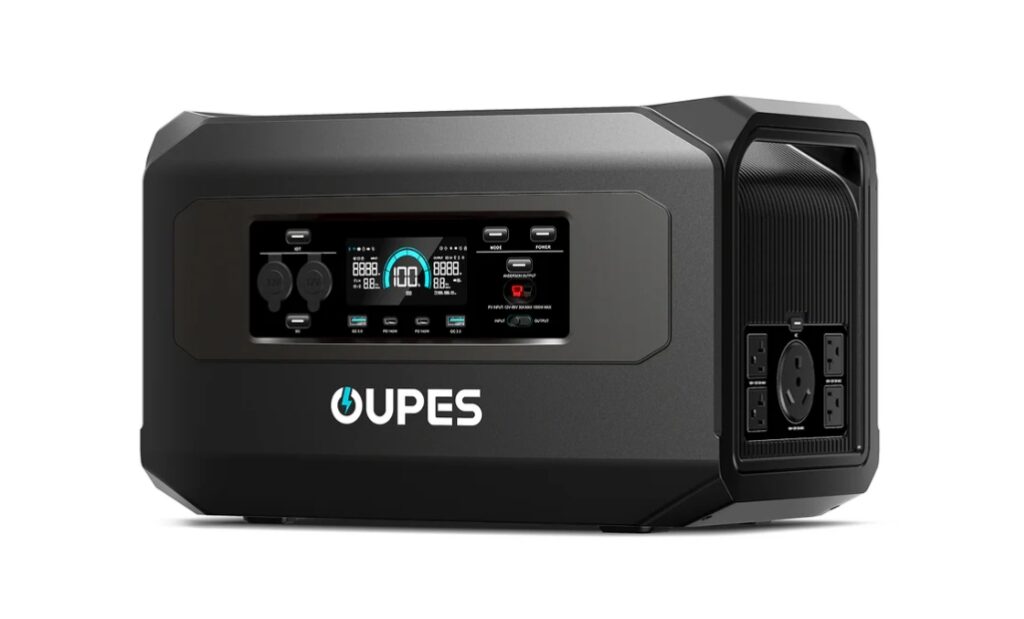
When a portable power station claims a 2kWh capacity and 2500W output, it moves beyond a camping accessory into the realm of serious backup power. The OUPES Mega 2 Pro makes these claims, positioning itself as a versatile unit for extended outages, remote work, and off-grid living. But specifications on a website only tell part of the story. Real-world performance under load, charging efficiency, and practical usability determine if a product is a premium tool or just a bulky battery.
This article provides a thorough, hands-on unboxing testing oupes mega 2 experience. We’ll move from the initial unpacking to a series of controlled discharge tests, evaluating its capabilities as both a portable powerhouse and a potential cornerstone for home backup power solutions. We’ll examine its construction, interface, and, most critically, how its 2048Wh capacity and 2500W pure sine wave inverter hold up when powering everything from sensitive electronics to high-wattage appliances.
First Impressions: Unboxing and Build Quality
The Mega 2 Pro arrives in a substantial, well-protected double-boxed package. Upon opening, the station itself is securely fitted with dense foam, accompanied by a robust AC charging cable, a car charging cable, and a comprehensive user manual. The unit’s physical presence is immediately notable. Weighing in at approximately 49 pounds (22.2 kg), it requires a two-handed lift but features well-integrated recessed handles that make transportation manageable.
The build quality feels industrial and premium. The casing is a textured, scratch-resistant plastic that conveys durability rather than brittleness. All ports are clearly labeled and feel solid, with no noticeable wiggle or play. The front panel houses the central control system: a clear, bright color LCD screen flanked by the AC output buttons, DC power button, and LED light controls. The layout is intuitive, with the heavy-duty cooling vents on the sides suggesting an awareness of the thermal demands of high-output use.
Port Selection and Placement
Port variety is a key strength. You get six AC outlets (three standard US duplex), two USB-C ports (one supporting 100W PD), two USB-A ports, a 12V car port, and two DC5521 outputs. This array covers nearly any conceivable device combination for a family or small team. The placement is logical, with AC outlets spaced to allow for bulky adapters without blocking neighboring ports.
Core Specifications and Charging Performance
Before testing discharge, we examined the Mega 2 Pro’s charging capabilities, which are as crucial as its output for off-grid utility. OUPES markets fast recharge times, and our testing largely validated these claims.
Using the included 800W AC adapter, we charged the station from 0% to 80% in just under 1.5 hours, with a full 100% charge achieved in about 2 hours and 15 minutes. This is impressive for a 2kWh unit and dramatically reduces downtime. For solar charging, the station supports up to 1200W input via its dual MC4 ports. With compatible panels, you can theoretically recharge in under two hours of ideal sunlight. We also tested the 12V car charging, which delivered a steady 120W, suitable for topping up during travel.
The OUPES Mega 2 Pro power station utilizes a LiFePO4 (LFP) battery, a chemistry known for its safety, longevity (over 3,500 cycles to 80% capacity), and stable performance across a wide temperature range. This choice signals a focus on long-term value and reliability over simply maximizing initial energy density.
Real-World Off-Grid Load Testing
Specification sheets mean little without context. We conducted a series of practical tests to evaluate the Mega 2 Pro’s performance under various loads, simulating common off-grid and backup scenarios.
Test 1: Sustained High-Wattage Load
To stress the 2500W pure sine wave inverter, we connected a 1500W space heater and a 600W coffee maker simultaneously, creating a ~2100W load. The Mega 2 Pro powered both without hesitation, and the inverter’s output remained stable, with no audible strain or flickering from the heater’s elements. The internal cooling fans became audible but were not obtrusive. This test confirms its ability to run essential high-draw home appliances like a refrigerator startup (which can surge over 2000W) or power tools.
Test 2: Mixed Device Runtime
A more realistic off-grid scenario involves mixed, lower-wattage devices. We powered a 55W laptop, a 10W LED lamp, a 40W Wi-Fi router, and a 70W 32-inch LED TV. The system drew around 175W. At this rate, the calculated runtime approached 11.5 hours, closely matching the station’s predicted output. The pure sine wave output ensured the sensitive electronics (laptop, TV) operated flawlessly.
Test 3: Overnight Phantom Loads
A critical aspect of home backup power solutions is efficiency at low loads. We left the station powering only the Wi-Fi router (40W) overnight. After 12 hours, it had used only 13% of its capacity, demonstrating very low parasitic loss from the inverter—a key detail for long-term, low-power applications.
Interface, Features, and Practical Usability
The color LCD screen is the operational hub. It displays remaining runtime (in hours and minutes) based on the current load, input and output wattage in real-time, battery percentage, and estimated time to full charge. This data-rich display is invaluable for managing power during an outage or off-grid session. You can make informed decisions, like knowing that running a microwave for 10 minutes will reduce your runtime by ‘X’ hours.
The companion mobile app, connecting via Bluetooth, mirrors the display and allows for remote on/off control of outlets. While the physical interface is comprehensive enough for most, the app is useful for monitoring from a distance or if the station is placed in an inconvenient spot. Other features include an adjustable bright LED light and a configurable auto-shutdown timer to conserve battery when devices are off.
Limitations and Considerations
No product is perfect, and the Mega 2 Pro’s strengths come with inherent trade-offs. Its weight, while manageable, makes it less “grab-and-go” than smaller units. For true portability, you’ll need a cart or plan to move it infrequently. While the 2500W output is substantial, it cannot replace a whole-house generator for those wanting to run central air conditioning or an electric oven simultaneously. It is best suited for powering critical circuits, a room, or a collection of essential devices.
Furthermore, to achieve the fastest solar recharge rates, you need a significant and potentially expensive solar panel array. The 1200W solar input is a capability, not a guarantee, dependent on optimal conditions and panel investment.
Frequently Asked Questions
How long can the Mega 2 Pro power a refrigerator?
It depends on the fridge’s size and efficiency. A modern, medium-sized 120W refrigerator running 50% of the time (a typical duty cycle) would draw an average of 60W. At that rate, the Mega 2 Pro could theoretically power it for over 30 hours. Always account for the higher startup surge, which the 2500W inverter can handle.
Can it be used while charging (pass-through charging)?
Yes, the OUPES Mega 2 Pro supports full pass-through charging. You can power devices from it while it is being charged via AC, solar, or car input. This is essential for creating a seamless backup system or for continuous operation during variable solar conditions.
Is an expansion battery available to increase capacity?
Yes, OUPES offers compatible external battery packs that can connect to the Mega 2 Pro, potentially doubling or tripling its total capacity. This modularity is a significant advantage for users whose needs may grow, such as for extended off-grid stays.
What is the warranty on the battery?
OUPES provides a substantial 5-year warranty on the Mega 2 Pro, reflecting confidence in the long-life LiFePO4 battery chemistry. Always review the official warranty terms for specific details and conditions.
How does it perform in cold weather?
The LiFePO4 battery performs better in cold temperatures than standard lithium-ion, but extreme cold still reduces efficiency and charging capability. OUPES specifies an operating temperature range, typically from 14°F to 104°F (-10°C to 40°C). For winter use, it’s best to keep the unit in a sheltered, insulated space if possible.
Conclusion
The hands-on unboxing testing oupes mega 2 process reveals a power station built with performance and durability as priorities. It successfully bridges the gap between portable power packs and stationary home backup systems. Its robust construction, clear interface, fast recharge capability, and most importantly, its stable high-wattage output make it a compelling choice for anyone serious about off-grid power, from homeowners preparing for outages to remote workers and camping enthusiasts requiring substantial, clean energy.
Ultimately, the OUPES Mega 2 Pro delivers on its core promises. It provides a reliable, user-friendly reservoir of power that can keep critical systems running for hours or even days. While its weight and the need for additional investment to maximize solar charging are factors to weigh, its combination of capacity, power, and the longevity of LiFePO4 chemistry offers tangible value. For those seeking a versatile and powerful energy platform, it stands as a top-tier contender in the crowded portable power market.